DepEd School Forms (SF1 to SF9) Complete Guide: Official Formats, Automation & Guidelines for Philippine Schools
A comprehensive breakdown of all 9 official DepEd School Forms (SF1 to SF9) and permanent records (SF10): legal mandates, reporting schedules, signatories, and how modern DepEd platforms automate school-wide compliance.
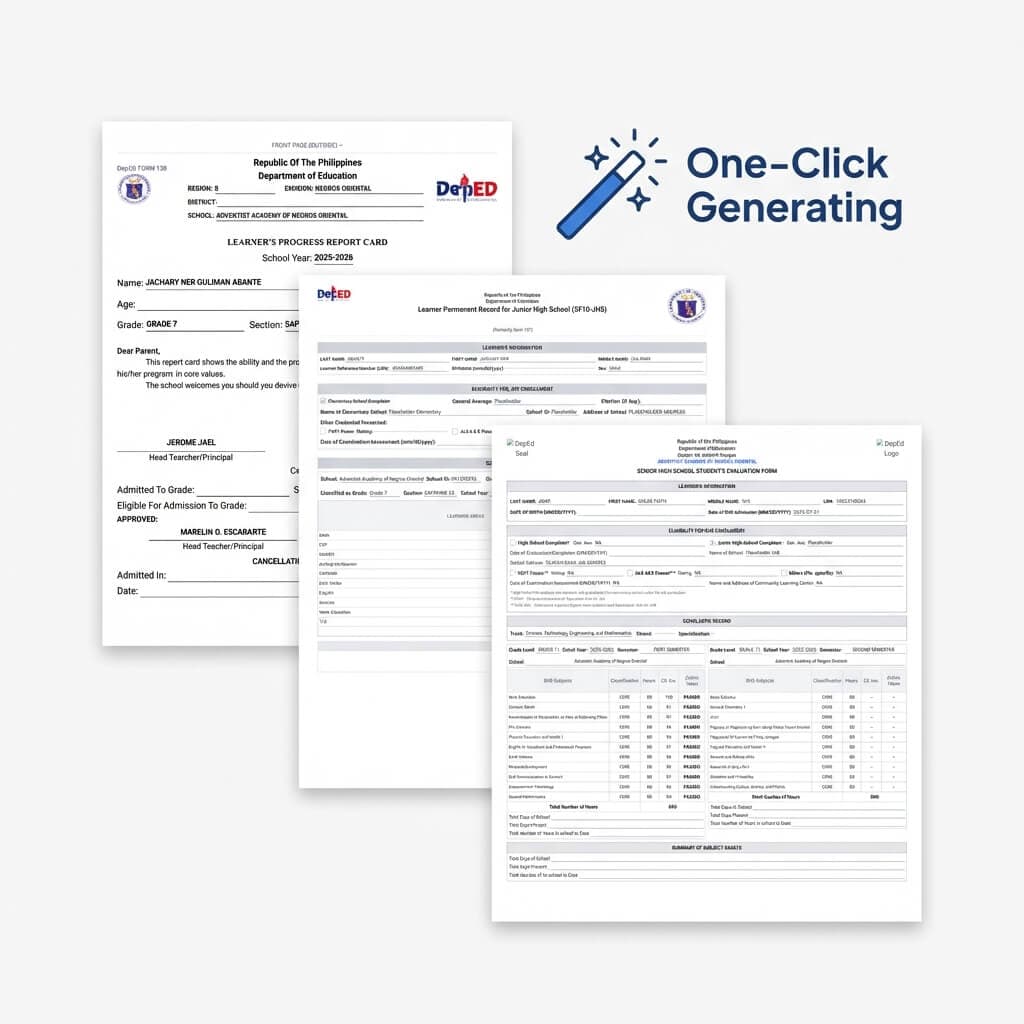
- Standardized School Forms (DO 4, s. 2014): DepEd unified disparate school records into standard School Forms 1 through 7, later expanded to include nutritional assessment (SF8), learner report cards (SF9), and permanent records (SF10).
- Single Source of Truth: Manual school management causes teachers to re-encode the same student names and LRNs up to 9 times. True DepEd platforms synchronize student rosters across all forms simultaneously.
- Core Forms for Class Advisers: Class advisers are primarily accountable for SF1 (Register), SF2 (Daily Attendance), SF3 (Books), SF5 (Promotion), and SF9 (Report Card / Form 138).
- Core Forms for School Heads: Principals consolidate school-wide data via SF4 (Monthly Movement), SF6 (End-of-Year Summary), and SF7 (Personnel Assignment).
- Automation with Sigasig: Sigasig functions as the premier DepEd-aligned school workspace, automating data flow from daily grading and attendance directly into Division-ready SF1 to SF9 exports.
1. The Regulatory Framework of DepEd School Forms
Prior to 2014, public and private elementary and high schools across the Philippines used fragmented, localized paperwork systems that varied drastically by division. In response, the Department of Education issued DepEd Order No. 4, s. 2014, titled Adoption of the Modified School Forms (SFs) for Public Elementary and Secondary Schools Effective End of School Year 2013-2014.
This was reinforced by DepEd Order No. 58, s. 2017 (Adoption of New School Forms for Senior High School) and DepEd Order No. 11, s. 2018 (Guidelines on the Preparation and Checking of School Forms). Today, whether an institution operates in Metro Manila or remote provincial divisions, strict compliance with SF1 through SF9 is legally required.
2. Complete Catalog of DepEd School Forms (SF1 to SF10)
Here is the exhaustive breakdown of every official DepEd form, its purpose, frequency, and authorized signatories:
School Register
Frequency: Beginning of School Year (BoSY) & Updated as needed | Signatory: Class Adviser & School Head
The master demographic inventory of enrolled learners. Records 12-digit Learner Reference Numbers (LRN), complete legal names, birth certificates, sex, birth dates, age as of 1st Friday of June, mother tongue, ethnic group, religion, complete residence address, and parent/guardian contact details.
Daily Attendance Report of Learners
Frequency: Daily Tracking, Monthly Submission | Signatory: Class Adviser & School Head
Detailed daily attendance record tracking presence, absences, tardiness, and cutting classes. Computes Average Daily Attendance (ADA) and monthly attendance percentages, while flagging Students at Risk of Dropping Out (SARDO) after 5 consecutive days of absence.
Books Issued and Returned
Frequency: Beginning and End of School Year | Signatory: Class Adviser & School Property Custodian
Official inventory tracking DepEd textbooks and Learner's Materials (LM) issued to each student by subject title, recording date issued, return condition, and financial accountability for lost or damaged books.
Monthly Learner's Movement and Attendance
Frequency: Monthly Consolidation | Signatory: School Principal / Head Teacher
School-wide monthly summary aggregating all SF2 data. Reports total registered enrolment, transfers-in, transfers-out, and cumulative dropouts disaggregated by grade level and sex for Division submission.
Report on Promotion and Level of Proficiency
Frequency: End of School Year (EoSY) | Signatory: Class Adviser, Division Representative, & SDS
The decisive end-of-year promotion roster. Calculates final General Weighted Averages (GWA), assigns official action taken (Promoted, Conditional, or Retained), identifies failed learning areas for remedial classes, and categorizes proficiency bands from Did Not Meet to Outstanding.
Summarized Report on Promotion & Learning Progress
Frequency: End of School Year | Signatory: School Principal & Schools Division Superintendent
Consolidated institutional summary aggregating SF5 data across all sections. Evaluates overall school passing rates, gender-disaggregated academic performance, and Mean Percentage Scores (MPS).
School Personnel Assignment List & Basic Profile
Frequency: Beginning of School Year & Staffing Updates | Signatory: School Principal
Faculty and non-teaching personnel inventory recording Plantilla item numbers, civil service eligibility, PRC license numbers, academic degrees, assigned subject teaching loads, and daily contact minutes.
Learner's Basic Health and Nutritional Status
Frequency: Baseline (BoSY) & Endline (EoSY) | Signatory: Class Adviser & MAPEH Coordinator / School Nurse
Captures student physical dimensions (weight in kg, height in meters) with automatic calculation of Body Mass Index (BMI). Classifies nutritional status (Normal, Wasted, Severely Wasted, Overweight, Obese) to identify beneficiaries for the national School-Based Feeding Program (SBFP).
Learner Progress Report Card
Frequency: Quarterly Card-Giving Day & End of School Year | Signatory: Class Adviser & School Principal
The official quarterly report card presented to parents and guardians. Form 138 displays transmuted quarterly grades (Q1–Q4), final subject ratings, Core Values evaluation (Maka-Diyos, Makatao, Makakalikasan, Makabansa), monthly attendance records, and promotion eligibility.
Learner's Permanent Academic Record
Frequency: Permanent Scholastic Archive | Signatory: Class Adviser, Registrar, & School Head
Formerly known as Form 137, SF10 maintains the continuous academic transcript of the learner from Grade 1 through Grade 12, documenting historical grades, remedial credits, and certified transfer records.
3. The Problem with Fragmented Spreadsheets
Despite DepEd's standardization, most schools continue to suffer from disconnected workflows. A class adviser enters student names into SF1, re-types them into SF2 for attendance, copies them into SF3 for textbooks, and re-pastes them into SF9 report cards. A single spelling correction or dropped student requires editing 9 separate files.
4. How Sigasig Unifies DepEd School Forms Automation
Sigasig functions as a unified DepEd platform and digital school workspace that establishes a single source of truth for your entire campus:
- Single Enrolment Input: Import your student roster once with LRNs, names, and birthdays. It populates SF1, SF2, SF3, SF5, SF8, and SF9 automatically.
- Daily Attendance to Monthly SF2: Mark attendance daily with one tap; monthly ADA, attendance percentages, and SARDO alerts calculate without manual math.
- Automatic Transmutation to SF9 Report Cards: Subject grades flow from teacher ECRs straight into the Class Adviser's consolidation ledger, populating Form 138 report cards ready for batch printing.
- Division-Ready Standards: 1-click export to official DepEd-formatted Microsoft Excel (.xlsx) and printable PDF documents conforming strictly to Division Checking Committee guidelines.
5. Experience Automated School Forms Today
Eliminate endless clerical paperwork and reclaim your teaching hours. Join thousands of Filipino educators using Sigasig to automate DepEd School Forms SF1 to SF9 seamlessly.
Prefer to work without internet? Sigasig Desktop brings offline scoring, SF2 attendance, and SF9 report card previews to Windows.